Introduction
While votes from some of yesterday’s election remain to be tabulated and some House districts have yet to be called, it is clear that the Democrats will control both chambers of Congress on January 3 and usher in an era of divided government. Historically, divided government has translated to reduced legislative activity and increased oversight. If the past is prologue, the administration likely will resist this oversight.
Our prevailing view is that the committees will respond by turning to companies with ties to the administration, seeking documents and other evidence from them in order to investigate the administration. These investigations could launch as early as January, and companies should use the time between now and the seating of the 120th Congress to assess exposure and prepare.
There’s opportunities to look at not just corporations that we think are enabling some of Trump’s corruption, but certainly corporations that are not supporting American families and not really focusing on affordability.
— Rep. Robert Garcia, expected chair of the House Committee on Oversight and Government Reform2
Understanding Congressional Investigation Risks
Unlike the administration, which can raise executive privilege in response to a congressional inquiry, companies generally cannot do so.1 A company has no executive privilege, and if it withholds documents because it believes the President’s privilege applies, there is significant risk that the company could end up the subject of a contempt vote.
A company need not be accused of anything. A federal contract, a permit or a settlement with the administration is enough.
Inquiries in minority letters could become majority-driven investigations
Our review of the letters sent by the minority to private companies and individuals, dated from the beginning of the 119th Congress to the present, shows that most focus on money and access to the administration: donations, sponsorships, business ties, and the contracts and appointments around them.
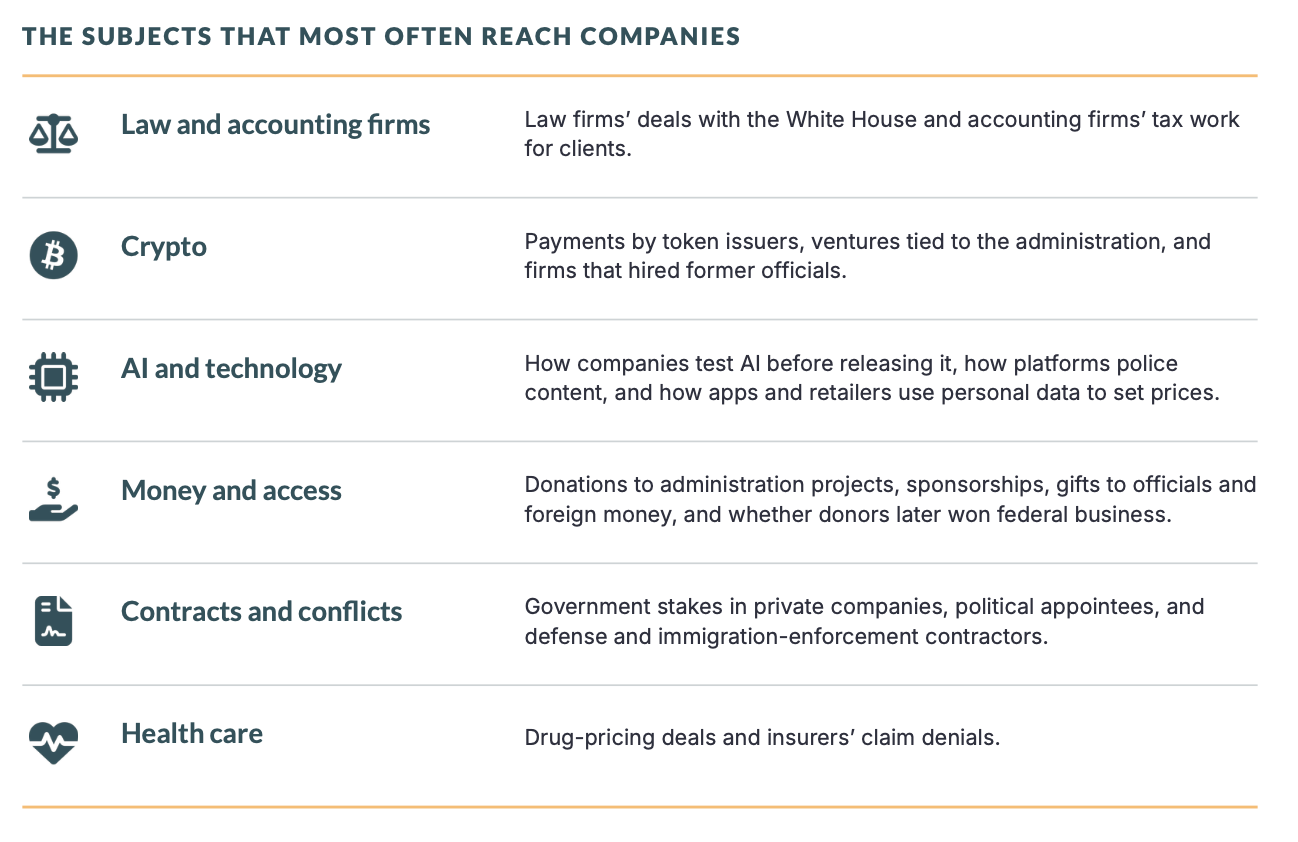
Bipartisan interest: Some of this does not depend on the election. Members of both parties are already investigating AI, surveillance, prediction markets and algorithmic pricing.
The Investigative Rules
We expect the House to keep two investigative tools from the 119th Congress and to consider a third.
In the House
- Chair subpoenas and staff-led depositions
Committees can let their chairs issue subpoenas without a vote,4 and every standing committee chair except Rules can order depositions taken by a member or committee counsel after consulting the ranking member.5 - Court enforcement through the Bipartisan Legal Advisory Group
In 2019 the House let committee chairs sue to enforce a subpoena when authorized by the Bipartisan Legal Advisory Group, a five-member leadership group with three members from the majority, and treated that vote as “the equivalent of a vote of the full House.”6 - Possible fines for witnesses
The House itself may look for a way to fine witnesses.7
In the Senate
- Rules set by March 1
Senate rules carry over from one Congress to the next, and each committee adopts and publishes its rules by March 1 of the first year of each Congress.8 - Subpoenas need agreement or a vote
Senate committee rules commonly require the ranking member’s agreement or a committee vote to issue a subpoena.9 - Court enforcement needs a resolution
And suing to enforce a subpoena against a private company or its employees requires a Senate resolution.10
While companies receiving a House subpoena can expect speed, the process in the Senate can be slower.
What To Do Before The Gavel
About 8 Weeks: Companies have about eight weeks before the new chairs take over, and are advised to use this period to prepare. Here are general items a company should consider:
- Step 01: Name an owner.
Put one senior executive in charge and involve the legal team. - Step 02: Map and preserve.
Know where your communications with the White House and agencies sit. Consider issuing targeted holds that reach messaging apps and personal devices used for business, and suspend auto-delete for the people involved. - Step 03: Set a process for White House Requests.
A White House request to withhold records does not excuse compliance with a subpoena. If one comes, preserve the records, engage counsel, and consider next steps. - Step 04: Reread any minority letter and any response.
Read it the way majority staff will. If the response has a material gap or error, consider correcting it as early as possible. - Step 05: Consider separate counsel.
Executives who dealt with the administration may need to be represented by independent counsel. - Step 06: Ensure that your answers to Congress are accurate and supported by the documents.
Anything produced to Congress can be made public, even without the company’s consent, and could be read alongside your regulatory filings, litigation positions and public statements.
1 In August, the Justice Department’s Office of Legal Counsel concluded that “presidential communications with private advisers can fall within the scope of executive privilege.” Applicability of Executive Privilege to Presidential Communications with Private Advisers, 50 Op. O.L.C. __, slip op. at 21 (Aug. 10, 2026), https://www.justice.gov/olc/media/1457271/dl. While this view is not binding on Congress, the administration could rely on it to claim privilege over particular presidential communications in a company’s files. The privilege itself is rooted in Article II and the separation of powers. See United States v. Nixon, 418 U.S. 683, 705–06, 708 (1974).
2 Nicholas Wu, Democrats Weigh How Harshly to Go After Firms That Courted Trump, Semafor (Feb. 27, 2026), https://www.semafor.com/article/02/27/2026/democrats-weigh-how-harshly-to-go-after-firms-courted-by-trump.
3 See, e.g., Press Release, Sen. Josh Hawley, Chairman Hawley Investigates AI-Powered Flock Cameras Amidst Privacy Concerns (Aug. 26, 2026), https://www.hawley.senate.gov/?p=7078; Press Release, H. Comm. on Oversight & Gov’t Reform, Comer Continues Investigation into Insider Trading on Online Prediction Market Platforms (Sept. 29, 2026), https://oversight.house.gov/release/comer-continues-investigation-into-insider-trading-on-online-prediction-market-platforms/; Press Release, H. Comm. on Energy & Com. Democrats, Pallone Launches Surveillance Pricing Inquiry (May 12, 2026), https://democrats-energycommerce.house.gov/media/press-releases/pallone-launches-surveillance-pricing-inquiry.
4 H.R. Rule XI(2)(m)(3)(A)(i), 119th Cong. (2025).
5 H.R. Res. 5, 119th Cong. § 3(t)(1) (2025) (enacted).
6 H.R. Res. 430, 116th Cong. (2019) (enacted); H.R. Rule II(8)(b), 119th Cong. (2025).
7 See, e.g., Press Release, Rep. Jamie Raskin, Raskin Co-Introduces Bill to Levy Penalties on Officials Who Defy Congressional Subpoenas (June 29, 2020), https://raskin.house.gov/press-releases?ID=1A6281DB-16BD-4DE2-93E6-DC720E45E4CE; H.R. Res. 1015, 119th Cong. (2026).
8 S. Rule V(2), XXVI(2), S. Doc. No. 113-18 (2013).
9 See, e.g., Rules of Procedure of the S. Comm. on the Judiciary § IX, 171 Cong. Rec. S785 (daily ed. Feb. 5, 2025); Rules of Procedure of the S. Comm. on Fin. R. 10, 171 Cong. Rec. S786, S787 (daily ed. Feb. 5, 2025). The Permanent Subcommittee on Investigations is an exception: its chair can issue subpoenas after notice to the ranking member and order depositions. Rules of Procedure, Permanent Subcomm. on Investigations of the S. Comm. on Homeland Sec. & Governmental Affs., R. 2, 9.1, 171 Cong. Rec. S1308, S1309 (daily ed. Feb. 24, 2025).
10 28 U.S.C. § 1365(a); 2 U.S.C. § 288d(a).
This client alert is not intended to serve as or replace traditional legal advice.
Scale LLP’s Congressional Investigations Team
Scale’s Congressional Investigations team is part of its broader White Collar & Investigations practice, bringing decades of experience representing companies and individuals in complex government investigations and related litigation. With backgrounds as former SEC Senior Trial Counsel and DOJ federal prosecutors, the team offers firsthand insight into enforcement priorities, investigative strategy, and effective defense. In addition to congressional inquiries and hearings, the practice handles SEC and other regulatory enforcement matters, Civil Investigative Demands, and criminal investigations. The team represents clients throughout the investigative and litigation lifecycle, from initial inquiries through interviews, depositions, resolution negotiations, and trial, while also conducting internal investigations and advising on compliance programs to mitigate risk.